home - Polymer Information
Polyvinyl Chloride (PVC)
Polyvinyl Chloride (PVC)
A versatile thermoplastic polymer known for its durability, chemical resistance, and cost-effectiveness in various applications
Key Properties
Physical Properties
- Density: 1.38-1.45 g/cm³
- Melting Point: 100-260°C
- Tensile Strength: 40-80 MPa
- Elongation at Break: 10-300%
Chemical Properties
- Chemical Resistance: Excellent
- Water Absorption: Very Low
- Solvent Resistance: Good
- Fire Resistance: Self-extinguishing
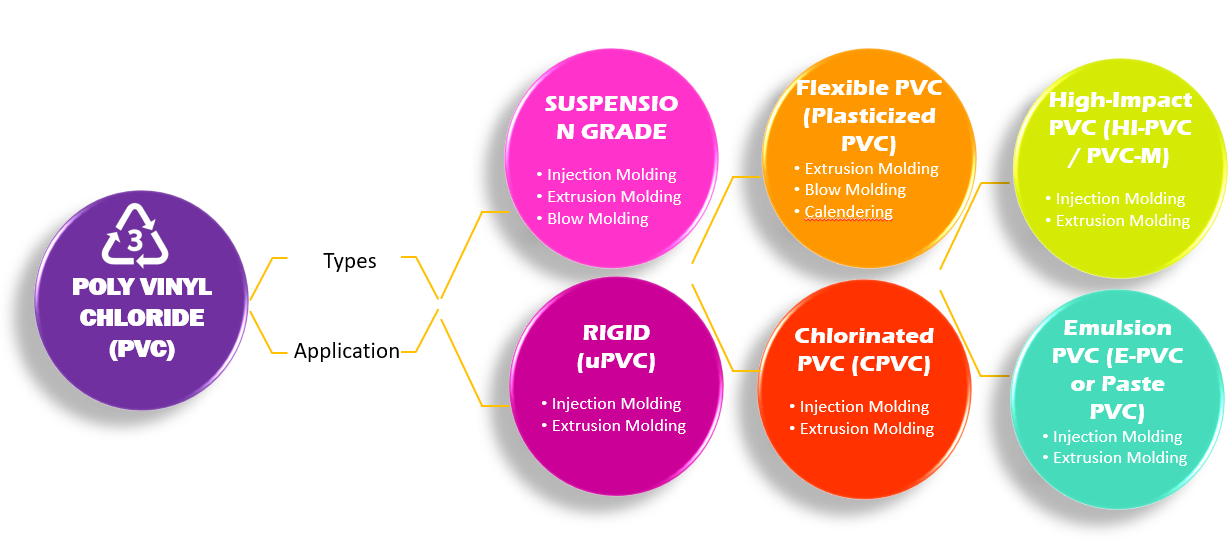
PVC Variants
Suspension PVC (S-PVC)
PVC produced through suspension polymerization, resulting in a granular form with excellent processing characteristics.
Rigid PVC (uPVC)
Strong, durable PVC without plasticizers, known for its excellent weather resistance and structural integrity.
Flexible PVC
PVC with plasticizers for enhanced flexibility and elasticity, suitable for applications requiring bendability.
Chlorinated PVC (CPVC)
Chemically modified PVC with enhanced heat resistance and improved chemical compatibility through chlorination.
High-Impact PVC (HI-PVC / PVC-M)
Impact-modified PVC with elastomeric additives to improve toughness and impact strength for demanding applications.
Emulsion PVC (E-PVC or Paste PVC)
PVC produced through emulsion polymerization, offering unique properties suitable for specialized applications.
PVC Variants Synopsis
| Grade / Type | Processing Methods | Key Properties | Typical Applications |
|---|---|---|---|
| Suspension PVC (S-PVC) | Extrusion, Injection molding | Strong, durable, weather-resistant | Pipes, window profiles, siding, sheets, credit cards |
| Rigid PVC (uPVC) | Extrusion, Injection molding | Strong, durable, weather-resistant | Pipes, window profiles, siding, sheets, credit cards |
| Flexible PVC | Extrusion, Calendering, Injection molding | Flexibility (due to plasticizers), chemical resistance, electrical insulation | Cables, hoses, flooring, synthetic leather, upholstery, medical tubing, IV bags |
| Chlorinated PVC (CPVC) | Extrusion, Blow molding | Chemically modified with higher chlorine content for superior heat and corrosion resistance | Hot water pipes, fittings, industrial chemical systems |
| High-Impact PVC (HI-PVC / PVC-M) | Extrusion, Injection molding | Impact-modified PVC with elastomeric additives to improve toughness and impact strength | Pressure pipes, exterior panels, weatherable products |
| Emulsion PVC (E-PVC or Paste PVC) | Extrusion, Injection molding, Calendering | Higher heat resistance, flame retardance | Synthetic leather, flooring, gloves, automotive sealants |
